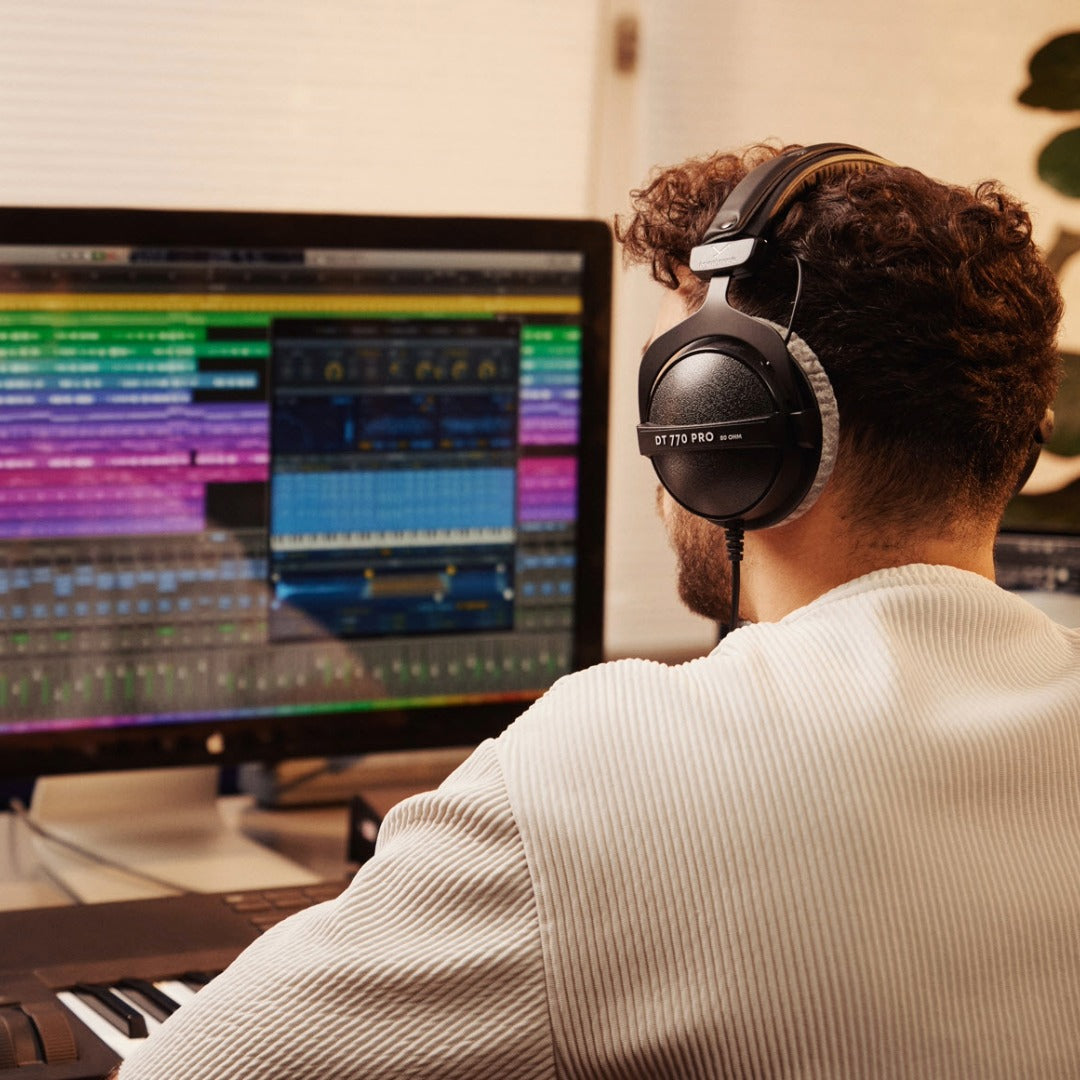

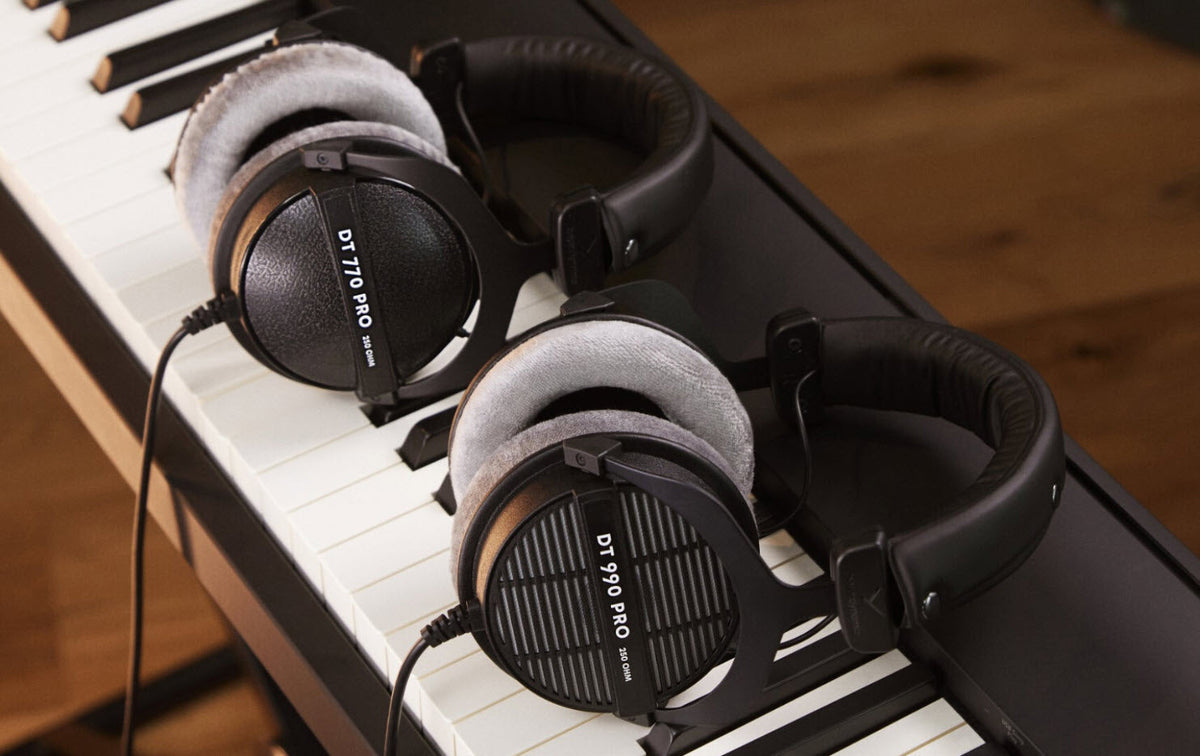
Walk into almost any recording studio, podcast booth, or bedroom production setup, and there's a good chance you'll spot one of these two headphones sitting on the desk. The beyerdynamic DT 770 PRO and DT 990 PRO have been industry staples for decades, and they remain two of the most recommended headphones for anyone getting serious about audio work. Both continue to be hand made in Germany, share the same rugged build quality, and even look nearly identical at a glance; same headband, same velour ear pads, same professional build quality and industrial design.
But underneath that shared DNA, they're built to do different jobs. One seals sound in; the other lets it breathe. That single architectural choice ripples out into everything from soundstage to comfort to which tasks each headphone excels at. This article breaks down the features, the practical benefits, and most importantly, which one you should buy based on how you plan to use it.
The Core Difference: DT 990 PRO Open-Back vs. DT 770 PRO Closed-Back
The single most important distinction between these two models is their acoustic design.
The DT 770 PRO is a closed-back headphone. The ear cups are sealed, meaning sound generated by the drivers stays inside the cup and outside noise is kept out, generally referred to as (passive sound isolation). This creates a more contained, isolated listening experience.
The DT 990 PRO is an open-back headphone. The rear of each ear cup is vented, allowing sound to pass freely in both directions. You'll hear more of the room around you, and anyone nearby will hear a faint version of what you're listening to as well.
This isn't a minor cosmetic difference; it fundamentally changes what each headphone is designed for. As an example, the closed design of the DT 770 PRO gives it excellent passive sound insulation, making it particularly well suited to studio recording, monitoring, and streaming situations where background noise can't be allowed to bleed into the headphone, or for that matter have audio easily leak out of the headphone when in use or near a live microphone.
That said the open back design of the DT 990 PRO creates a genuine soundstage that makes it the better tool for mixing and mastering work where spatial accuracy matters most. In addition, due to the DT 990 PRO's detailed and accurate sound stage it has become a go-to product in the world of Gaming, especially in (FPS) first-person-shooter games that require detailed spatial accuracy to determine the direction of sound during the game for a competitive advantage.
DT 770 PRO: Features and Sound Signature
Key specs: 45mm dynamic drivers, available in 32, 80, and 250-ohm versions, a nominal frequency response of 5Hz-35,000Hz.
The DT 770 PRO sound signature would be described as one that reproduces the entire frequency range with precision, along with delivering low frequencies in punchy detail. A signature that both engineers and listeners have come to love over several decades.
Bass: Because the ear cup is sealed, the low end has real body and physical impact. Kick drums and sub-bass lines feel weighty and present, which is part of why the DT 770 PRO is such a popular choice for a wide range of music and applications that as Bass specific.
Isolation: The closed-back design is the headphone's defining practical advantage. It blocks meaningful outside noise and, just as importantly, prevents sound from leaking out - critical for anyone recording near an open microphone.
Comfort: The DT 770 PRO uses plush velour ear pads with a snug and secure fit, making them ideal for hours of use.
DT 990 PRO: Features and Sound Signature
Key specs: 45mm dynamic drivers, available in 80, and 250-ohm versions, a nominal frequency response of 5Hz-35,000Hz.
The DT 990 PRO on the other hand, has the edge when it comes to music editing or for cutting and editing videos, because it is possible to perceive details very clearly and distinctly, which is a great advantage in the production of a mix.
Bass: Its Bass profile is characterised as a rich bass, but the sound signature in general is more analytical, spacious and transparent, the open-back design of the DT 990 PRO comes into play as it enables outstanding spatiality in the sound reproduction, giving detailed (tonal depth) -i.e. It plays back the arrangement of the sound sources in a room and thus also conveys an overall impression of all the sounds in the room - from "front" to "back". Imagine a band performing on a stage: The drums are usually positioned at the back, the guitar, bass and piano are a little further forward, and the lead singer is in the front row. This is precisely the set-up that you want to reproduce in the mix with various tools.
Soundstage and imaging: This is where the DT 990 PRO genuinely separates itself. The open-back design creates an airy, spacious feel that makes it easier to place instruments and sounds within a mix, or to pinpoint direction and distance in a computer game or film.
Comfort:
The DT 990 PRO also uses plush velour ear pads with a snug and secure fit, making them also ideal for hours of use. That said, thanks to the Open-Back earcup design, many users may say that the temperature within the earcup feels slightly cooler on the face during long sessions.
Both models are available across multiple impedance variants, and the choice matters depending on your source device. The 32-ohm DT 770 PRO version is ideal for small plug-and-play devices that use rechargeable batteries such as phones, tablets and laptops; the 80-ohm versions act as a versatile studio all-rounder that performs well with modest interfaces, and the 250-ohm versions are aimed at professional mixing consoles and audio interfaces, generally requiring a dedicated headphone socket and/or amp to reach their full potential.
Application Examples:
Recording and tracking vocals or instruments.
DT 770 PRO. If a microphone is anywhere nearby, isolation isn't optional, any sound leaking from open-back headphones can bleed straight into the live microphone. The 770's sealed design also lets a performer monitor their own vocal or instrument take without spilling click track or backing music into the room.
Mixing and mastering.
DT 990 PRO. When the whole point of the exercise is judging the spatial placement, depth, and balance of a mix, the open-back soundstage becomes a genuine working advantage. Subtle panning decisions, reverb tails, and stereo width are all easier to evaluate accurately.
Podcasting and streaming.
DT 770 PRO. Isolation prevents the host's own voice or game audio from leaking into a microphone positioned inches away, and it keeps the outside world from intruding during a live session.
Gaming.
Genuinely subjective depending on the requirement. The DT 990 PRO's wider soundstage can make positional audio - footsteps, gunfire direction, environmental cues - easier to place accurately. On the other hand, the DT 770 PRO is favoured by streamers specifically because it won't leak game audio into a live mic, even though its narrower stage is slightly less ideal for competitive positional cues.
Commuting or shared spaces.
DT 770 PRO. If you value privacy. The reason being is that the DT 990 PRO's open design means anyone sitting near you will hear a thin, tinny version of your audio, and in addition you'll hear plenty of the room/office sounds in return.
Critical listening or classical and acoustic material.
DT 990 PRO. The expansive imaging and airy top end suit music where spatial detail is the ideal. i.e. (The placement of instruments across a stage, or the decay of a room's natural reverb).
Editing video or podcasts.
DT 990 PRO tends to have the edge for detail work, since it's easier to catch small flaws like a poorly EQ'd frequency or an awkward edit point when nothing is being reinforced or contained by a sealed chamber.
Build quality and longevity:
Both use steel-reinforced headbands, replaceable ear pads and headbands. A wide range of spare parts are available to refresh your DT 770 PRO or DT 990 PRO investment.
Cable version options:
It is worth noting that each impedance version of both the DT 770 PRO and DT 990 PRO have different cables by way of types (straight/coiled) and length. All versions are supplied with a 6.35mm screw on adaptor jack.
DT 770 PRO:
DT 770 PRO 32 ohm: 1.6mtr straight cable
DT 770 PRO 80 ohm: 3 mtr straight cable
DT 770 PRO 250 ohm: 3 mtr coiled cable
DT 990 PRO:
DT 990 PRO 80 ohm: 3 mtr straight cable
DT 990 PRO 250 ohm: 3 mtr coiled cable
Which One Should You Buy?
Taking the above into consideration, the decision really does come down to one question: do you need good passive isolation, or do you need a detailed soundstage?
Choose the DT 770 PRO if you record, track vocals or instruments, stream or podcast near an open mic, commute with your headphones on, or generally need to control what sound gets in and out during your listening experience.
Choose the DT 990 PRO if you work primarily in a quiet, controlled room, spend your time mixing or mastering, want the widest possible soundstage for critical listening, or simply prefer a more open, spacious feel and don't need to worry about sound leakage.
Neither headphone is a strict upgrade over the other - they're built for different applications and uses. Many working audio professionals own both, reaching for the 770 during tracking and recording sessions and switching to the 990 once it's time to sit down and mix.
We hope that the information above is of assistance to you.